Category: Recruitment

  • Experimental Evidence on Undergraduate Recruitment: Lessons from Creating a Subject Pool Registry

    Experimental Evidence on Undergraduate Recruitment: Lessons from Creating a Subject Pool Registry

    Laura Paul, Leah Palm-Forster, and Kent Messer

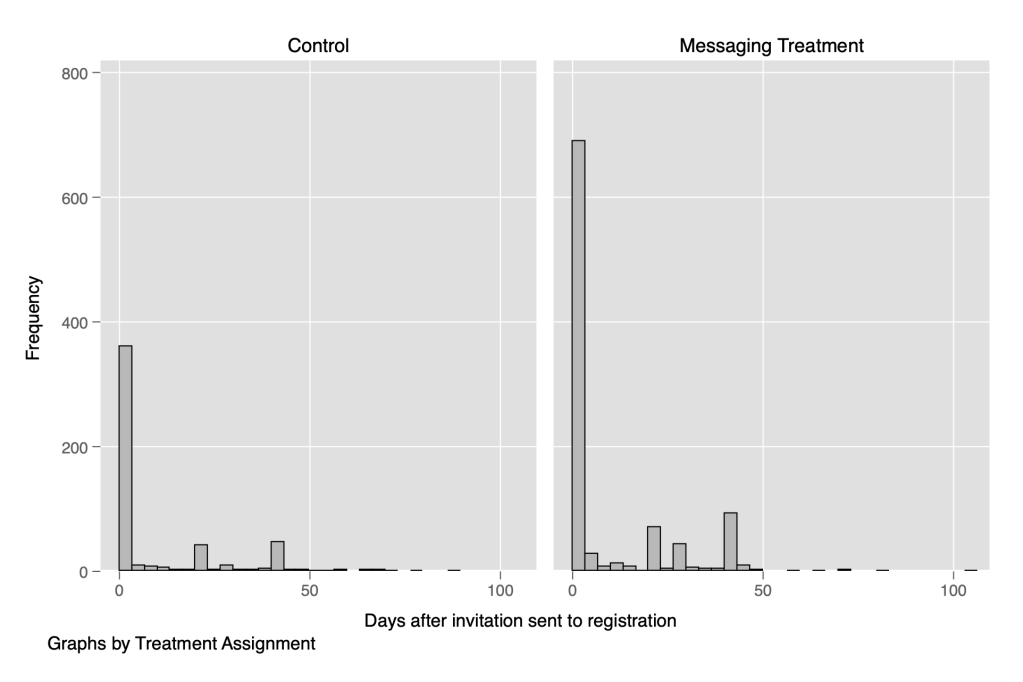
    Recruitment of subjects is a critical step for any data collection. This project aims to identify the best practices for inviting university students by email to register for a program. We are creating a recruitment pool for future experiments at a large research university in the mid-Atlantic. Our email invitation will test the effect between two messages, randomly assigned to each student. These messages are based on lessons from behavioral economics: does a message mentioning the potential to receive monetary compensation for participation increase response of students? We will evaluate registration by message treatment to identify the most effective way to invite students to register. The introduction of this recruitment registry is a unique opportunity to address a research question on recruitment with a large sample size. To date, 20,696 experimental emails have been sent. In total, 1,216 undergraduates have registered for the participant pool after receiving an invitation, and there is evidence of a treatment effect (7.79% registered from monetary compensation message, 3.95% for control message).

  • Challenges in Recruiting U.S. Farmers for Policy-Relevant Economic Field Experiments

    Challenges in Recruiting U.S. Farmers for Policy-Relevant Economic Field Experiments

    Collin Weigel, Laura Paul, Paul Ferraro, and Kent Messer

    Featured Article in the AEPP. First published: 28 September 2020.

    Available at https://doi.org/10.1002/aepp.13066

    Abstract: To develop evidence-based agricultural policies, researchers increasingly use insights from economic field experiments. These insights are often limited by the challenges of recruiting large and representative samples of farmers. To improve the effectiveness and cost-efficiency of farmer recruitment, researchers should apply the same experimental methods to the recruitment process that they apply to their main research questions. Here we experimentally evaluate ten recruiting strategies in two large-scale, high stakes experiments. We find that monetary incentives and reminders are effective, but costly. Costless strategies, such as prominently citing a well-known institution as the sponsor, had positive but small, effects on recruitment.