Category: Experiment

  • Experimental Evidence on Undergraduate Recruitment: Lessons from Creating a Subject Pool Registry

    Experimental Evidence on Undergraduate Recruitment: Lessons from Creating a Subject Pool Registry

    Laura Paul, Leah Palm-Forster, and Kent Messer

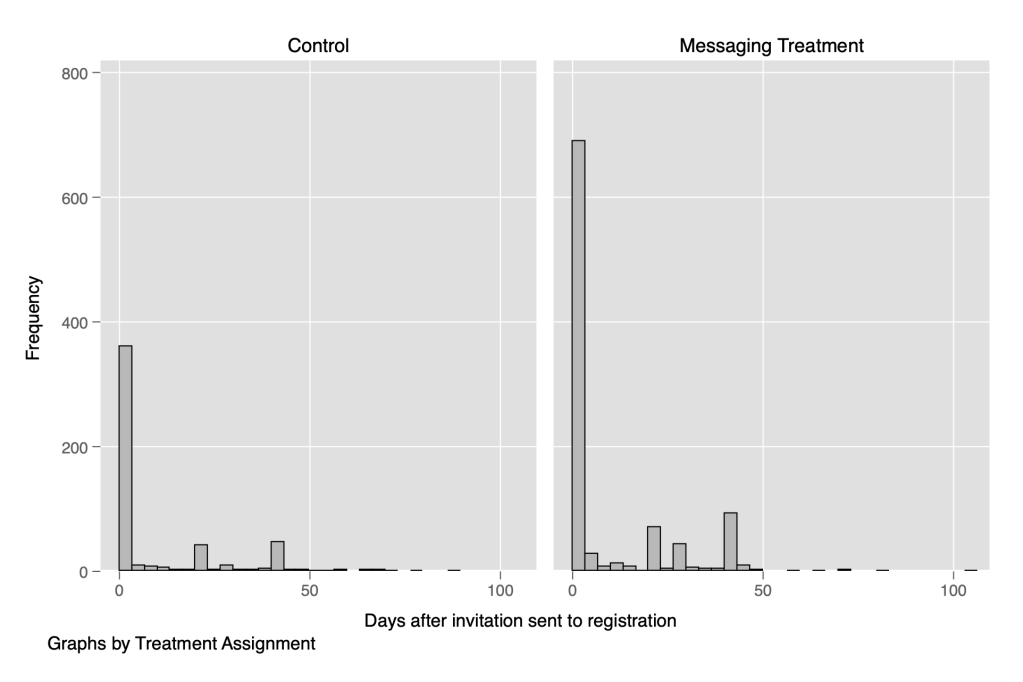
    Recruitment of subjects is a critical step for any data collection. This project aims to identify the best practices for inviting university students by email to register for a program. We are creating a recruitment pool for future experiments at a large research university in the mid-Atlantic. Our email invitation will test the effect between two messages, randomly assigned to each student. These messages are based on lessons from behavioral economics: does a message mentioning the potential to receive monetary compensation for participation increase response of students? We will evaluate registration by message treatment to identify the most effective way to invite students to register. The introduction of this recruitment registry is a unique opportunity to address a research question on recruitment with a large sample size. To date, 20,696 experimental emails have been sent. In total, 1,216 undergraduates have registered for the participant pool after receiving an invitation, and there is evidence of a treatment effect (7.79% registered from monetary compensation message, 3.95% for control message).
  • Measures of Willingness to Pay and Willingness to Accept  in Consumer Valuation Experiments

    Measures of Willingness to Pay and Willingness to Accept in Consumer Valuation Experiments

    Tongzhe Li, Laura A. Paul, Kent D. Messer, and Harry M. Kaiser

    Abstract:

    Willingness to pay (WTP) and willingness to accept (WTA) measures are commonly used for economic analysis with wide-ranging implications for consumer demand, social welfare, marketing, policy, and economic theory. Economic studies have often observed an inconsistency between WTP and WTA—where elicited WTP is generally lower than WTA relative to what behavioral models would predict—but explanation of the WTP-WTA gap remains unresolved. Notably, the gap is largest for things that have large and relatively unknown value, such as the value of biodiversity in the Brazilian rainforest, in contrast to something that is smaller and has a relatively well-known value – such as a $5 bill.

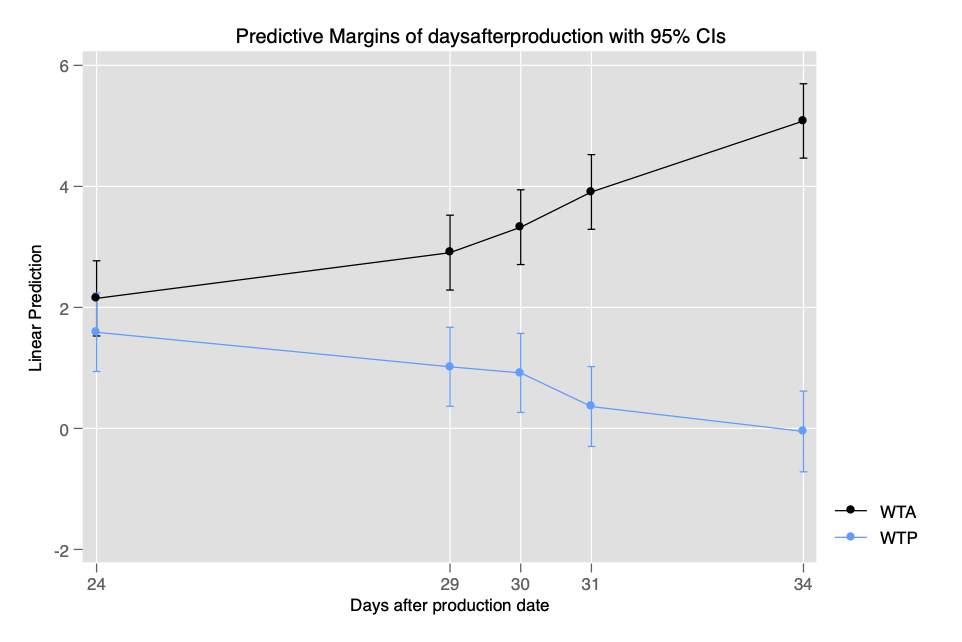
    Our paper informs situations where food choices might be best framed with either WTP or WTA using a framed field experiment with 292 adult subjects who participated in either a conventional or a reverse Becker-DeGroot-Marschak (BDM) auction designed to elicit consumer WTP (product purchasing) or WTA (task performing) for yogurt smoothies of various known production dates. Two important findings arise from this design. First, production date and labeling have consistent marginal effects on valuation regardless of the auction format, which suggests that either WTP or WTA estimates in the experimental auction literature can likely result in consistent policy implications. Second, there is a significantly different proportion of zero bids at each production date, which signals the existence of censoring. In a situation where some consumers might have a significant negative response to a product, a zero WTP value is not sufficient data and WTA should be collected.

  • Demand for an Environmental Public Good in the Time of COVID-19: A Statewide Water Quality Referendum

    Demand for an Environmental Public Good in the Time of COVID-19: A Statewide Water Quality Referendum

    George Parsons, Laura Paul, and Kent Messer

    Abstract: Due to COVID-19, many households face hardship — unemployment, an uncertain economic future, forced separation, and more. At the same time, the number of people participated in outdoor recreation is reported to be on the rise, as it was one of the few activities still permitted. How these experiences affect the public’s willing to pay for environmental public goods is unknown. During the pandemic, we conducted a stated preference survey to value statewide water quality improvements in Delaware. While a majority of participants report experiencing hardship of some sort (economic, emotional, etc.), mean household WTP declined by only 7% post-COVID. Based on our results, legislation being debated at the time of the outbreak passes a benefit-cost test (and majority vote) either pre- or post-COVID.

  • Nudge or Sludge? An Experimental Game Illustrating How Misunderstood Scientific Information Can Change Consumer Behavior

    Nudge or Sludge? An Experimental Game Illustrating How Misunderstood Scientific Information Can Change Consumer Behavior

    Laura Paul, Olesya Savchenko, Maik Kecinski, and Kent Messer

    Scientific information can be designed to help people understand and describe the natural world. Consumers regularly seek out information about their food and drink to help inform their decisions. While this search is generally viewed as a positive process, it becomes troubling when consumers respond negatively to scientific information, even when this scientific information does not intend to convey a negative signal. This misunderstanding and stigmatization can be difficult from the perspective of federal and state regulations related to the labeling of food and drink. Labels have often been compared to the “nudges” popularized by behavioral economics. Nudges are low-cost interventions made at the time of a decision, and they can have large effects on behavior, but they have been referred to as “sludges” when they end up misleading people. The objective of this paper is to introduce an engaging and interactive classroom activity using a second-price auction and an informational label treatment to introduce behavioral economics and measurement of its effects. Additional classroom discussion topics are presented, including comparing nudges and sludges, the public response to the treatment of tap water, and the role of safety information in consumer response.

  • Bundling Stress Tolerant Seeds and Insurance for More Resilient and Productive Small-scale Agriculture

    Bundling Stress Tolerant Seeds and Insurance for More Resilient and Productive Small-scale Agriculture

    NBER Working Paper No. 29234 (link)

    Steve Boucher, Michael Carter, Jon Einar Flatnes, Travis Lybbert, Jonathan Malacarne, Paswel Marenya, and Laura Paul

    Risk often inhibits on-farm investment by smallholder farmers. Recent evidence indicates that index insurance and stress tolerant seeds can separately and partially offset this risk effect. In this study, we explore whether the complementarities between these two risk management technologies can be harnessed to underwrite a resilient, high productivity small farm sector. Utilizing a multi-year randomized control trial that spanned two countries and exploits natural variation in weather shocks, we find that drought tolerant maize seeds mitigate the impact of mid-season drought. Compared to farms in control villages, where shocks have persistent effects that reduce future investment and productivity, those with access to both drought tolerant seeds and multi-peril index insurance show greater resilience and immediately bounce back from shocks. Experiential learning is key to realizing this resilience effect: Farmers who experienced shocks intensify their subsequent use of the technologies and exhibit what we call resilience-plus, while those who did not experience shocks disadopt. Together these findings showcase important complementarities between these risk mitigating technologies and the crucial role learning plays in tapping their potential stochastic and dynamic benefits to small farmers.